Most creators have launched nothing. Not because they lack ideas, and not because the market does not want what they are building. The real reason is simpler and more frustrating: they do not know what to do next. Every stage of a digital product launch feels like a new decision with no clear answer, and that uncertainty compounds until the product quietly disappears. Understanding the six phases of a digital product launch does not just give you a checklist. It gives you a sequence, and that changes everything.
There is a specific kind of exhaustion that comes from working hard on something for months and still having nothing to show for it. You have the Notion workspace, the product concept, maybe even a half-finished document. But the gap between “almost ready” and “actually live” feels impossible to cross. What lives in that gap is not a lack of effort. It is a missing framework for what comes after each step.
This article maps those steps clearly. Each phase has a purpose, a set of decisions to make, and a concrete output that makes the next phase possible. Follow the sequence and the product gets launched. Skip phases or run them simultaneously and the product stalls.
Why digital product launches need a defined phase structure
The creator economy has a framing problem. Most of the content about how to sell digital products online treats launching as a single event: you build the thing, you post about it, you wait for sales. That framing sets creators up to fail because it skips the operational reality of what a launch actually requires.
A launch is not a moment. It is a process with distinct stages, each with its own work and its own outputs. Treating it as one big task is why creators build products nobody buys, write sales pages nobody understands, and announce things to audiences who have no idea why they should care.
Defining the phases of a digital product launch forces clarity at each stage before moving to the next. It prevents the most common failure mode in the creator space, which is spending months building the wrong thing in the wrong format at the wrong price, then wondering why it did not sell.
A launch without a defined phase structure is not a launch. It is a series of disconnected tasks that never add up to a shipped product.
Phase 1 of a digital product launch: Idea Discovery
The first phase is the most skipped and the most misunderstood. Most creators treat idea generation as the starting point, but the real work of Phase 1 is idea narrowing. The goal is not to find an idea. Most creators already have ten. The goal is to choose one and define it with enough precision that everything built in Phase 2 actually solves a real problem for a real buyer.
A properly completed Idea Discovery phase produces three things: a specific buyer (not “entrepreneurs” but “solopreneurs running service businesses under five people”), a specific problem that buyer has right now (not “they want to grow” but “they lose two hours a day to tasks they cannot delegate”), and a specific outcome the product will deliver (not “a productivity system” but “a client onboarding workflow that runs without them”).
Validation belongs here too, and skipping it is expensive. Validation does not mean running a survey or asking friends if your idea is good. It means finding evidence that people are already paying for solutions to this problem, that the pain is real enough to motivate action, and that your angle on the solution is distinct enough to be worth considering. Look at what is selling on Gumroad. Read the reviews of similar products. Find the communities where your buyer lives and watch what questions come up repeatedly.
The output of Phase 1 is a single sentence: who this product is for, what problem it solves, and what outcome it delivers. If you cannot write that sentence clearly, Phase 2 will pull in five directions at once. Before moving forward, use our guide to validating your digital product idea to make sure the foundation is solid.
Phase 2 of a digital product launch: Product Shaping
Idea and product are not the same thing. An idea is a direction. A product is a defined deliverable with a format, a scope, a delivery method, and a price. Phase 2 is where the idea becomes a product, and it happens entirely before any content is created.
Choose the right format for your buyer
Format is the first decision. A PDF guide, a Notion template, a video course, a spreadsheet system, a swipe file, a mini-workshop, an email sequence. Each format carries different production costs, different perceived value, and different buyer expectations. The right format is not the one you are most comfortable building. It is the one that best matches how your buyer wants to consume the solution. Someone who processes information visually may want a template they can fill in. Someone who needs explanation before application may want a short guide followed by a template. Match the format to the learning behavior, not to your preference.
Define scope before you start building
Scope is the second decision, and getting it wrong is the most common reason first products never ship. Scope is the amount of ground your first version covers. The correct scope for a first version is the minimum required to deliver the core promise. Not every feature. Not every use case. Not the complete system you eventually want to build. The version that exists is always more useful than the version being perfected.
Set your price before you build, not after
Price is the third decision, and it is the one creators most often defer because it forces a real commitment. Pricing a digital product requires answering a direct question: what is the outcome worth to the buyer, and what does that make a fair exchange? For a first product from a creator without an established audience, the range between $19 and $79 covers most scenarios. Under $19 and the product feels disposable. Over $79 without an established reputation and the friction increases significantly. The exact number matters less than choosing one before building starts, because it shapes every other decision from scope to positioning.
Product shaping is the phase most creators skip entirely. They move from idea to building without defining what they are building, which is why they keep rebuilding it.
Phase 3 of a digital product launch: Building the First Version
Phase 3 is where most of the visible work happens, and where most of the invisible damage is done. Builders tend to expand scope mid-build, add sections that were not in the original outline, redesign the template after finishing half of it, and generally find ways to make the first version into a second version before the first one has ever been seen by a buyer.
The discipline of Phase 3 is staying inside the scope defined in Phase 2. Every time a new idea appears during building, it goes on a list called “version two.” Not because the idea is bad, but because the goal of version one is to produce something real and deliverable, not something complete and comprehensive. Completeness is earned through feedback, not through anticipation of every possible need.
Build speed matters here in a specific way. A first version built in two weeks and launched is more valuable than a first version built over four months and still in progress. The faster the product reaches the market, the faster real feedback replaces imagined feedback. Real feedback is the only kind that improves a product. Everything else is speculation.
Quality still matters, but quality in the context of a first version means clarity, not polish. A clearly written PDF that solves the stated problem is a high-quality first version. Something beautifully designed that does not quite address the buyer’s actual workflow is not. Prioritize clarity of outcome over quality of presentation. The presentation can always improve later. The value proposition has to be right from the start.
Phase 4 of a digital product launch: Sales Page and Positioning
The sales page is where most digital products fail commercially, even when the product itself is good. A product without a clear sales page relies on the buyer doing the work of figuring out why they should buy it. Most buyers will not do that work. They will move on.
Writing a sales page for a digital product is not a copywriting exercise. It is a positioning exercise. The page has to answer four questions in order: who is this for, what problem does it solve, what will life look like after using it, and why should the buyer trust that this product delivers. Every element of the page, from the headline to the description to the price display, serves one of those four questions.
The headline is the most critical element and the most commonly written wrong. Most creators write headlines that describe what the product is. The buyer does not care what the product is. The buyer cares what the product does for them. “A Notion template for freelancers” is a description. “Stop losing client work to scattered notes and missed follow-ups” is a reason to keep reading. The headline earns the next paragraph. The next paragraph earns the scroll. The scroll earns the decision.
Length is not the issue. Clarity is. A sales page can be four paragraphs or fourteen sections depending on how much context the buyer needs to feel confident. For a lower-priced first product selling to a buyer who already understands their problem, four to six focused sections is usually enough: headline, problem, solution, what is inside, who it is for, price and call to action. For full guidance on writing each section, our complete guide to writing a sales page for a digital product covers the process in detail.
Phase 5 of a digital product launch: The Launch Itself
Phase 5 is where most creators both underinvest and overthink simultaneously. They underinvest in the actual distribution, posting once and calling it a launch. And they overthink the timing, the platform, the format of each post, the length of the email, the hour of the day, none of which matters as much as whether they reach enough people with a clear enough message enough times.
Structure your launch as a sequence, not a single post
A launch is a sequence of communication events, not a single announcement. The sequence has a beginning, a middle, and an end, and each part has a different job. The beginning creates awareness: the product exists, here is who it is for, here is what it solves. The middle creates consideration: here is what is inside, here is why it is priced the way it is, here is what a buyer can expect. The end creates urgency: the launch window is closing, or the introductory price is ending, or this is the last time the creator will be promoting it for a while.
Without that sequence, a “launch” is just an announcement. Announcements are easy to miss and even easier to ignore. A sequence builds presence. Each piece of communication catches a different buyer at a different moment of readiness, which is why the same launch sent to the same audience three times over five days outperforms a single post by a significant margin.
Prioritize reaching the right people over reaching more people
Distribution matters more than perfection here. Reaching 200 relevant people with a clear message beats reaching 2,000 general followers with a vague one. Think about where your specific buyer already spends time. Send them to the sales page. Let the sales page do the converting.
If you are building without an existing audience, this phase feels impossible until you realize that an audience is not a prerequisite for a first sale. It is a long-term asset. The first sale comes from direct outreach, relevant communities, niche platforms, and partnerships, not from follower counts. Our full guide to launching a digital product without an audience covers each of those channels in practical detail.
Phase 6 of a digital product launch: After the First Sale
Phase 6 is the phase that determines whether the first launch was a one-time event or the beginning of a business. Most creators treat the first sale as the finish line. It is the starting line for everything that comes after.
The first sale delivers something no amount of research or preparation can provide: a real buyer’s perspective on the product. What did they understand from the sales page? What surprised them inside the product? What did they find most useful? What was unclear? What did they want that was not there? Each piece of that feedback is worth more than any competitor analysis or market research because it comes from someone who valued the product enough to pay for it.
Collecting that feedback does not require a complex system. A short follow-up email sent three to five days after purchase, asking three direct questions, generates enough insight to meaningfully improve both the product and the positioning before the next launch. What made you buy this? What has been most useful so far? What would make it better? Three questions. The answers will tell you what to fix, what to emphasize on the sales page, and what to build next.
Phase 6 also includes a review of the launch mechanics themselves. Which piece of communication drove the most clicks? Where did buyers come from? What objection came up most in replies or questions? That data shapes the next launch, and the one after that, until launching starts to feel like a skill rather than a gamble.
The first sale is not a reward for finishing. It is a source of information. Treat it that way and every subsequent launch gets easier.
What happens when creators skip phases
The six phases work as a sequence because each one creates the conditions the next one depends on. Skipping a phase does not save time. It creates a deficit that shows up later, usually in the form of a launch that does not convert, a product that does not satisfy buyers, or a creator who cannot figure out why something that seemed so solid is not working.
Skipping Phase 1 means building the wrong product for the wrong buyer. The product might be technically good and still find no market, because the market was never clearly identified before the building began.
Phase 2 skippers run into a different problem: building without a defined scope, which leads to scope creep, an overbuilt first version, and a launch that keeps getting pushed because the product is never quite finished enough.
Arriving at launch day with no sales page is the cost of skipping Phase 4. A page written in two hours the night before launch is not a sales page. It is a product description, and product descriptions do not sell products.
Skipping Phase 6 means the first launch is also the last one, because without feedback there is no improvement, and without improvement the second launch faces the same obstacles as the first.
Each phase is doing real work. The creators who launch consistently are not more talented. They are more systematic.
How the Digital Product Launch System applies these phases
Understanding the six phases of a digital product launch is useful. Having a structured environment that guides you through them in sequence is what actually gets products shipped.
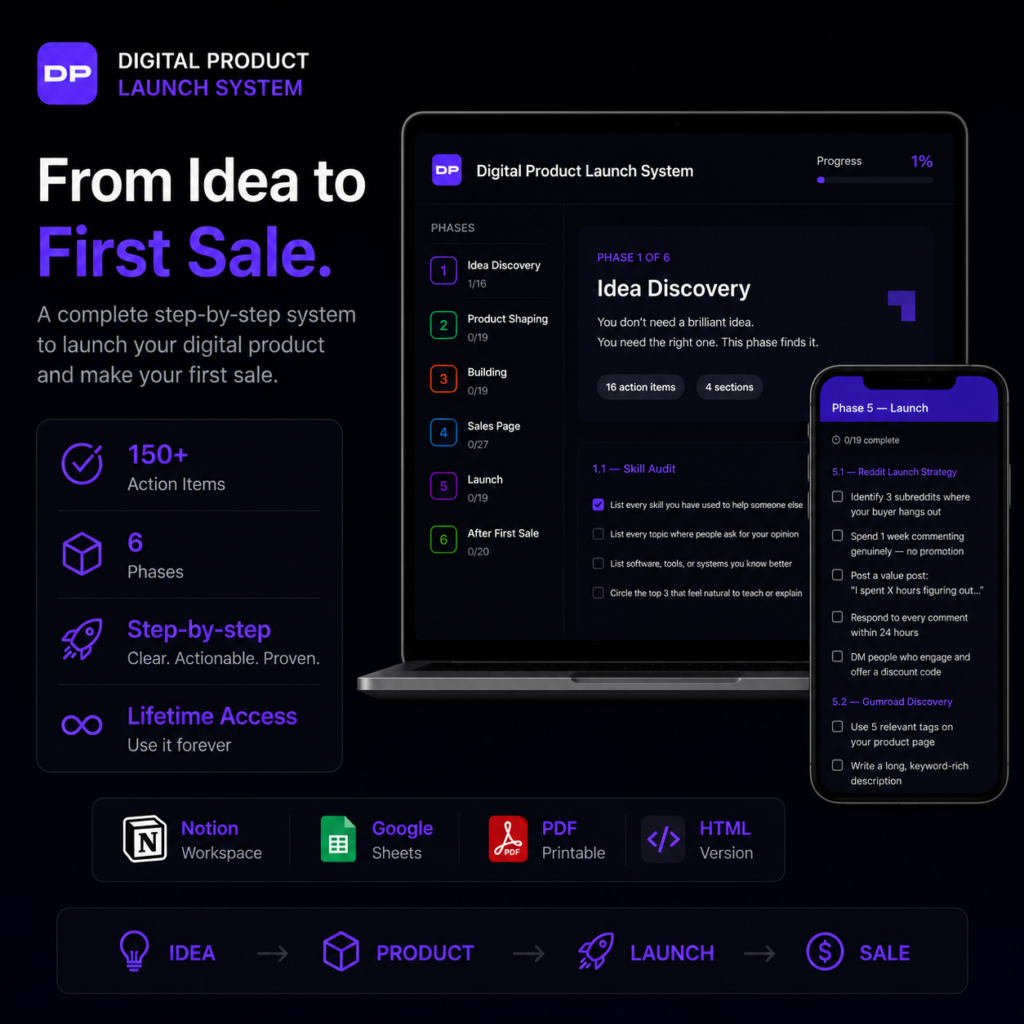
The Digital Product Launch System is built around these exact six phases. Each phase has its own workspace inside the core Notion Launch Workspace, with the decisions to make, the questions to answer, and the outputs to complete before moving forward. It does not let you skip phases. It does not let you loop back indefinitely. It creates the structure that carries a creator from a raw idea to a live, selling product without the chaos of figuring out what comes next at every step.
Alongside the Notion workspace, the system includes an Interactive Launch Guide that walks through the reasoning behind each phase, a Google Sheets Launch Tracker for creators who prefer managing their process in a spreadsheet, and a Printable Launch System for those who work better on paper.
The goal is not to make launching feel easy. Launching is not easy, and anything that promises otherwise is selling something that does not deliver. The goal is to make launching feel navigable, because navigable problems get solved and unsolved launches do not reach buyers.
The phases do not change. The product does.
One of the most useful things about a defined phase structure is that it applies to every digital product you will ever build. The specific decisions inside each phase will change depending on the product, the buyer, and the platform. But the sequence stays the same. Idea Discovery before Product Shaping. Product Shaping before Building. Building before the Sales Page. Sales Page before Launch. Launch before Feedback.
That sequence is not arbitrary. Each phase feeds the next with the information and clarity it needs to produce a good outcome. Idea Discovery comes before Product Shaping because you cannot shape what you have not defined. Building comes after shaping because scope without building is just planning. The Sales Page comes before Launch because distributing without a clear offer is noise. And feedback comes last because it is only possible once something real has been purchased. Running them in order is not slow. Running them in order is what makes the launch possible at all.
The creator who understands these phases and works through them with discipline will always outpace the creator who is more talented but less structured. Talent determines the ceiling. Process determines whether you ever reach it.
Most creators already have what it takes to build a product people want. What they are missing is the sequence that gets it in front of those people. Now you have the sequence.