The most common reason creators delay their first digital product launch has nothing to do with the product. It is the belief that launching without an audience means launching into silence. No followers, no email list, no built-in buyers. So why bother? This belief is understandable. It is also wrong, and it keeps more capable creators stuck than almost any other obstacle. You do not need an audience to make your first sale. You need a clear product, a clear offer, and a clear path to the people who already have the problem your product solves.
This article is about that path. Not a theoretical one, but a practical sequence of channels, approaches, and decisions that work specifically for creators launching their first digital product with zero existing following.
Why the audience-first belief stalls most first launches
The logic seems reasonable on the surface. More followers means more reach. More reach means more sales. So build the audience first, then launch the product. This is the advice that fills most creator content, and it leads to a specific failure mode: creators who spend a year building an audience and never build the product, or creators who build the product and then spend another year waiting until the audience feels large enough to justify launching.
Neither approach leads to a first sale. The audience-first model has a real place in a mature creator business. For a first product, it is a trap. It converts a two-month problem into a two-year problem and gives the creator a socially acceptable reason to keep waiting.
The reality is that an audience is a distribution asset, not a launch requirement. Distribution is what you need on launch day. Distribution is reaching the right people with the right message at the right moment. An audience is one source of distribution. It is not the only one, and for a first launch, it is not even the most efficient one. Targeted access to a small number of highly relevant buyers consistently outperforms broad access to a large number of loosely relevant followers.
You do not need ten thousand followers to make your first sale. You need ten people with the problem your product solves to know it exists.
What you need before you think about distribution
Before any of the launch channels in this article will work, two things have to be in place. Without them, no amount of distribution will produce a sale.
A product that solves a specific problem for a specific person
Vague products do not sell to audiences, and they especially do not sell without one. A digital product needs to solve a problem specific enough that the buyer recognizes themselves in the description immediately. Not “a productivity system for entrepreneurs” but “a weekly planning template for freelance designers who lose track of client work across multiple projects.” The narrower the target, the easier it is to find those people and the more likely they are to buy when they find the product.
If the product is not this specific yet, that is the starting point. Our guide to validating your digital product idea covers how to sharpen the problem definition before moving to distribution.
A sales page that converts without your reputation doing the work
When you have an established audience, your reputation does a significant portion of the selling before anyone reads the sales page. Buyers already trust you. They have seen your work. They know how you think. For a first launch without an audience, none of that pre-existing trust exists. The sales page has to do all of it alone.
This means the page needs to be clearer and more specific than you might think is necessary. The headline has to name the problem. The description has to explain the outcome. The “what is inside” section has to be concrete enough that the buyer can picture using it. Social proof, if you have any, belongs here too, even if it is a quote from someone who tested the product, a screenshot from a community discussion that validates the problem, or a testimonial from a beta user. For a detailed walkthrough of each section, our guide to writing a sales page for a digital product covers the full process.
Channel 1: Direct outreach to people with the problem
Direct outreach is the fastest and most underused distribution channel available to a creator without an audience. Most creators skip it because it feels uncomfortable. Sending a message to a stranger about something you built feels presumptuous. It feels like selling. In practice, done with the right framing, it feels like a recommendation from someone who found something relevant.
The key distinction is targeting. Direct outreach only works when the person receiving it actually has the problem the product solves. Reaching out to a hundred random people in a creator community is spam. Reaching out to ten people who have publicly asked about the exact problem your product addresses is a service.
How to find the right people to contact
Start with public signals of the problem. Search Twitter, Reddit, Facebook groups, and niche forums for people who have described the exact frustration your product solves. Someone who posted three weeks ago asking “how do other freelancers manage their client onboarding process” is a qualified prospect for a freelance onboarding template. They told you they have the problem. They did not ask you not to contact them.
Reach out with a short message that acknowledges their specific post, explains what you built, and offers them either early access or a direct link. Do not pitch. Describe. “I saw your question about client onboarding last month. I just finished building a Notion template that handles exactly that. Happy to share it if it would be useful.” Three sentences. No pressure. The person who has the problem will respond. The person who does not will ignore it, and that costs you nothing.
Channel 2: Relevant online communities
Every niche has communities. Reddit threads, Facebook groups, Discord servers, Slack communities, Circle spaces, forum boards. These communities exist because people with a shared problem or interest found each other. They are the most concentrated source of relevant buyers available to a creator who has not yet built their own following.
How to contribute before you distribute
The mistake most creators make is entering a community with a launch announcement as the first message. That approach gets posts deleted and accounts banned because it is, by any reasonable measure, spam. The approach that works is contribution before distribution.
Spend one to two weeks in the community before mentioning the product. Answer questions. Share useful observations. Engage with what other people are saying. Become a recognizable presence. When you eventually mention the product, it lands as a recommendation from a community member, not an advertisement from a stranger. The same message about the same product produces dramatically different results depending on whether the sender is a known contributor or an unknown outsider.
When you do share the product, frame it around the problem the community discusses, not around the product itself. “I kept seeing the same question here about managing client feedback across revisions, so I built something to handle it. Here is the link if it is useful.” That framing respects the community’s purpose and positions the product as a solution to a shared problem rather than a commercial interruption.
Channel 3: Niche platforms where your buyer already shops
An audience you do not have to build exists on every platform where people browse and buy digital products in your category. Gumroad’s discovery pages, Etsy’s digital downloads section, Creative Market, Notion’s template gallery, Product Hunt, AppSumo Marketplace. Each of these platforms has built-in traffic from people actively looking for solutions to their problems.
How to optimize for discoverability on these platforms
Listing on a platform is not enough. Most products listed on Gumroad or Etsy receive no organic discovery because the listing itself does not communicate the value clearly. Platform optimization follows the same logic as the sales page: the title should name the problem, not just the product type. “Freelance Client Onboarding Template” is a product name. “Never Lose a Client Brief Again: Freelance Onboarding System for Designers” is a promise. On a discovery platform where buyers are scanning dozens of options, the second version earns the click. The first one disappears.
Tags and categories matter too. Use the specific terms your buyer would type into a search bar, not the terms that describe your product in the abstract. Think about the frustration first, then describe the solution in terms of that frustration.
The platforms where your buyer already shops have built-in audiences. Your job is not to build traffic. Your job is to show up clearly enough that the right buyer recognizes the product as theirs.
Channel 4: Content that targets the problem directly
Content marketing without an audience sounds paradoxical, but it operates differently from content built for social following. The goal here is not to build a following. The goal is to show up in search results, forum discussions, and community feeds when someone searches for information related to the problem your product solves. One well-placed article, thread, or video that ranks for a specific search term can drive consistent traffic to a sales page for months without any ongoing effort.
How to create content that drives sales, not just traffic
The most effective content for a creator without an audience is content that addresses the exact problem the product solves, one layer above the product itself. If the product is a freelance proposal template, the content is “how to write a freelance proposal that wins projects.” The article teaches the skill. The product accelerates the implementation. Someone who reads the article and understands the framework is a highly qualified buyer for a template that handles the execution.
Publish this content wherever your buyer searches. A blog post optimized for a specific search term. A detailed Reddit comment that answers a common question. A YouTube video that addresses a specific frustration. A Quora answer that provides genuine value. Each piece of content that lands in front of the right person is a low-friction introduction to the product.
Channel 5: Partnerships with people who already have the audience
You do not have an audience. Someone else does. That is not a barrier. It is an opportunity, if the product is strong enough and the approach is right.
How to approach partnerships as a first-time creator
Partnerships do not require equal audience sizes. They require aligned audiences and a clear value proposition for both parties. A newsletter writer with 3,000 subscribers who serves exactly your target buyer is more valuable than a creator with 50,000 general followers. The question is what you can offer in exchange for access to that audience.
Revenue share is the most common arrangement and the most accessible for a creator without an existing reputation. Offering 30 to 50 percent of each sale attributed to the partner’s link requires no upfront payment and aligns incentives directly. The partner only benefits if the product actually sells to their audience, which means they will only promote it if they genuinely believe it is relevant.
The pitch to a potential partner should be short, specific, and focused on their audience’s benefit. “I built a tool that solves a problem I see your audience mention regularly. Here is the product. Here is what the revenue share looks like. Would you be open to sharing it if you think it is a fit?” No pressure. The partner who says yes has given you access to a warm, relevant audience. The partner who says no costs you nothing.
How to run a first launch without an audience: the sequence
Each channel works better as part of a sequence than as a standalone action. A first launch without an audience does not need to be large. It needs to be focused. Here is a practical sequence that covers the first two weeks of a product launch for a creator starting from zero.
Week one: warm the channels before the launch
In the seven days before the product goes live, do three things. Identify the five to ten communities where your buyer is most active and spend time contributing genuinely to each one. Find ten to fifteen people who have publicly described the problem your product solves and prepare a short, specific outreach message. Identify two or three potential partners whose audiences match your buyer profile and draft a partnership proposal.
Do not mention the product yet. This week is about presence, not promotion. You want to be a familiar name in the right rooms before you ask for attention.
Week two: the launch sequence
On day one of launch week, publish the product and send the direct outreach messages. On day two, post in the communities where you have been contributing, framing the product as a solution to the shared problem. On day three, follow up with outreach recipients who opened but did not respond. On day four, publish the problem-focused content piece that links to the product. On day five, send the partnership proposals. On days six and seven, respond to every comment, question, and message the launch generated.
This is not a passive launch. It is an active one. The creator who sends twenty targeted messages, contributes to five communities, and follows up consistently across seven days will always outperform the creator who posts once and waits.
What to do with the data from a first launch without an audience
A first launch generates information regardless of whether it generates sales. The absence of sales from a direct outreach campaign tells you something different from the absence of sales from a platform listing. Responses that say “interesting but not for me” tell you something different from no responses at all. Pay attention to where the friction appears.
If the outreach generates responses but no clicks to the sales page, the positioning in the message is unclear. If clicks happen but no purchases follow, the sales page is not converting. If purchases happen but buyers ask questions that are answered in the product, the sales page is not communicating the value clearly enough. Each failure point points to a specific fix, and that specificity is only available to creators who launched something and watched what happened.
This is why the first launch matters even when it does not go perfectly. It replaces speculation with data. And data is the only thing that makes the second launch meaningfully better than the first. For a complete walkthrough of how to structure each stage of the launch itself, our guide to the six phases of a digital product launch covers the full process from idea to first sale.
The audience will come. But the first sale cannot wait for it.
Building an audience is a legitimate long-term strategy for a creator business. It compounds over time, reduces the cost of each future launch, and creates a direct relationship with buyers that no platform can fully replicate. None of that changes the fact that the audience does not exist yet, and waiting for it before launching the first product is a decision that costs months or years of real business progress.
The channels in this article work because they connect a specific product to specific people who already have the problem it solves. They do not require a following. They require clarity about who the buyer is, a product that genuinely addresses their situation, and the willingness to reach out before the reach has been built passively.
The first sale is not the culmination of an audience-building strategy. It is the beginning of one. Make it, learn from it, improve the product, and build the audience on top of evidence that the product works rather than on hope that it might.
An audience makes launching easier. A strong product with a clear offer makes the first sale possible without one. Start with the product. The audience follows the proof.
The system that makes this repeatable
Running each of these channels manually for every launch is possible once. Making it repeatable requires a structured process that tracks what worked, what did not, and what to do differently next time. The Digital Product Launch System is built for exactly this. Each launch phase, including the distribution sequence for creators without an existing audience, has its own workspace inside the core Notion Launch Workspace. The system includes outreach tracking, community channel planning, and a launch sequence template that can be adapted to any product and any audience size, including zero.
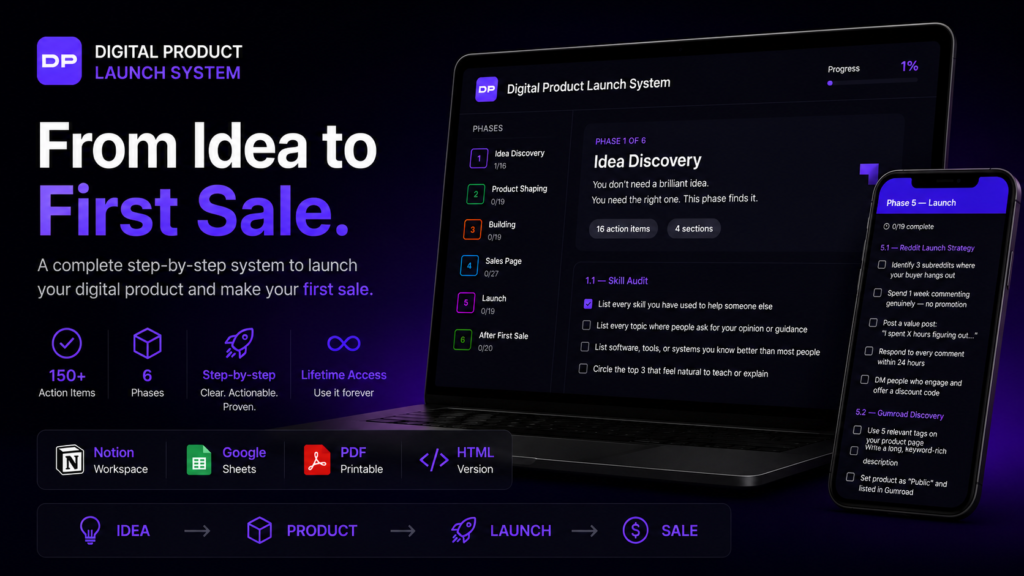
Alongside the Notion workspace, the Google Sheets Launch Tracker handles the quantitative side: outreach sent, responses received, clicks generated, conversion rates by channel. The Interactive Launch Guide walks through the reasoning behind each decision. And the Printable Launch System gives you a physical reference for the full launch sequence when you need it away from a screen.
The first launch is the hardest one. Not because the market is hostile, but because everything is uncertain for the first time. A structured system does not remove that uncertainty. It gives you a clear path through it.