Most creators struggling to sell digital products online don’t have an idea problem. They have a launch problem. And the difference between creators who ship consistently and those who stay stuck comes down to one thing: a structured digital product launch system. This article breaks down what that system looks like, why most products fail before the market ever sees them, and how to build a repeatable launch process that works even when motivation fades.
You know that feeling. You open Notion on a Sunday afternoon, fully motivated. There it is: the folder you built three months ago. Digital product ideas, half-written outlines, a saved tutorial about sales pages, a rough pricing table you abandoned, a color palette for a brand you never launched. You feel the excitement again. You move a few cards. You rename a page. You open a new tab and start researching a different angle on the same idea.
By evening, nothing has shipped. But somehow the idea feels more developed than before.
This is not a motivation problem. Talent is rarely the issue either. And in most cases, the ideas are perfectly good. Most creators who are genuinely capable of building digital products never launch them, not because the ideas are bad, but because there is no structured system to carry them from idea to income.
That gap is what this article is about.
The internet has created a generation of overprepared creators
There has never been more freely available information about how to build digital products. YouTube channels, Twitter threads, newsletters, cohort courses, masterclasses: the volume of content about how to launch is extraordinary. And yet, for most solo creators, launch rates remain close to zero.
Here is the uncomfortable truth: consuming content about launching feels like making progress. Watching a tutorial about sales pages, bookmarking a pricing framework, joining a creator community, redesigning your logo one more time. All of it generates the sensation of forward motion without the accountability of actual output.
Creators have gotten very good at managing the appearance of progress. Notion dashboards exist for products that are nowhere near done. Content calendars get built for launches that never happen, and saved templates pile up for emails that have never been sent to a list that does not yet exist.
The problem is not preparation. Preparation is valuable. The problem is that preparation has become a permanent state, a comfortable place to live that never requires the discomfort of publishing something and finding out if people actually want it.
Ideas create excitement. Systems create momentum. And most creators have far more of the first than they have ever built of the second.
Most creators are not building products. They are managing uncertainty.
Launch avoidance is not laziness. It is a rational response to fear. An unfinished product cannot be rejected by the market. A sales page still being written cannot be criticized. And a creator still choosing between a PDF guide and a Notion template has not yet exposed themselves to the judgment that comes with actually shipping.
Perfectionism is the most socially acceptable form of avoidance available to creators. It disguises itself as professionalism. “I want to make sure it’s really good before I launch” sounds responsible. But in practice, it becomes an indefinite delay mechanism, one that can stretch across months and years while the creator redesigns the cover image for a product that does not yet exist.
Then there is the idea-switching problem. A creator builds 30% of a Notion productivity template, then encounters a tweet about faceless YouTube channels, pivots immediately, builds nothing, and two weeks later is researching AI tools for content creation. Each pivot feels like an upgrade. Each abandoned project is rationalized as a lesson. But the cumulative result is always zero shipped products and a growing cemetery of half-built ideas.
The emotional pattern underneath all of this is the same. Uncertainty about whether the thing will work creates discomfort, and the creator responds to that discomfort by doing something that feels productive but carries no real risk. More research. More planning. More optimization of things that do not matter yet.
The real problem is not ideas. It is a broken launch process.
Most unfinished digital products do not die because of bad ideas. Scattered execution kills them.
A creator might have a genuinely good idea: a content calendar template for small business owners, a freelance proposal guide, an Arabic product description generator for e-commerce sellers. The idea is sound. The potential buyer exists. The product could actually help someone. But without a structured product launch process to move from idea to finished product to launched offer, the creator spins in circles until motivation fades and the idea quietly disappears into an archived folder.
This is where the concept of a digital product launch system becomes critical. Not a productivity hack. Not a morning routine. A repeatable, structured framework that takes the creator through each stage of the product lifecycle, so that execution is guided by a clear sequence rather than left to the chaos of whatever feels relevant on any given day.
The market cannot reject a product that never launches. But the creator pays the cost of that silence anyway, in time, in momentum, and in the slow erosion of belief that any of it is actually possible.
What is a digital product launch system?
A digital product launch system is a structured workflow that helps creators move from idea to product to sale, without losing momentum along the way. It is not a to-do list. It is not a calendar template. It is a sequenced operational environment that defines what to do at each stage of the launch process, in what order, and why.
A proper digital product launch system takes a creator through six distinct phases: idea clarity, product shaping, building the first version, writing the sales page, launching, and processing the feedback that comes after the first sale. Each phase has a defined purpose, a set of decisions to make, and a clear output that feeds the next phase.
The goal of a launch system is not to make the process perfect. It is to make the process repeatable. Because the creator who launches an imperfect product and iterates on real feedback will always outperform the creator who spends six months building something no one has seen yet.
To understand the full creator workflow behind this approach, Gumroad’s creator resources and ConvertKit’s guide to selling digital products are worth reading alongside this article.
Why most digital products fail without a launch system
When a digital product fails in the traditional sense, we imagine a creator who launched something and heard silence: no sales, no response, no validation. That scenario does happen. But it is far less common than the failure that happens before launch, the product that was never finished, never positioned, never priced, never published.
This invisible failure is the dominant pattern in the creator economy. Products die in Notion folders, in half-written Google Docs, in the space between “I have a great idea” and “I will work on it this weekend.” The market never rejected them. The creator simply never made them available for rejection in the first place.
The cost of this pattern extends beyond the lost product. Every unfinished launch is a tax on the creator’s confidence. Each abandoned idea makes the next one slightly harder to start. Over time, the creator begins to identify as someone who has ideas but does not follow through, which becomes a self-fulfilling narrative that is very difficult to escape through motivation alone.
The solution is not more confidence. It is a system that does not require confidence to function. A system that carries the creator through the uncomfortable parts of building, through the moment when the product feels too simple, or the sales page feels awkward, or the price feels arbitrary, by providing structure where willpower would otherwise fail.
The six phases of a digital product launch system
Most creators understand these phases intellectually. The problem is that without a system to move through them in sequence, they collapse into each other. Here is what each phase actually requires.
Phase 1: Idea Discovery
This phase is not about generating more ideas. It is about narrowing down to one. The goal is to define the specific buyer, the specific problem, and the specific outcome the product will deliver. Nothing gets built until this is clear. Validation belongs here too: look for evidence that people are already paying for solutions to this problem before committing to building anything.
Phase 2: Product Shaping
Once the idea is chosen, the product needs to be shaped before any tool is opened. What format will it take? What scope is appropriate for a first version? How will it be delivered? What is the price? These decisions form the offer architecture, and making them early prevents the scope creep and tool-switching that kill most products in the building phase.
Phase 3: Building the First Version
The first version should contain only what is necessary to deliver on the core promise. Nothing more. Resist the temptation to add features, expand the scope, or improve the design before anyone has used it. The goal of version one is to produce something real, testable, and deliverable. Everything else is version two.
Phase 4: Sales Page and Positioning
The sales page is where most creators lose confidence and skip ahead to “soft launching” by posting on social media without a proper offer page. That approach rarely works. A clear sales page, written around the buyer’s problem rather than the product’s features, is the infrastructure that makes a launch repeatable. It does not need to be long. It needs to be clear.
Phase 5: Launch
A launch is not a single post. It is a sequence of events: telling people the product exists, explaining who it is for, giving them a reason to buy now rather than later, and following up with those who showed interest. Treating the launch as a real business event, with a defined start and a defined end, changes the outcome significantly compared to a casual mention buried in a thread.
Phase 6: After the First Sale
The work does not end at the first sale. This phase is about collecting feedback from real buyers, understanding who purchased and why, and using that information to improve both the product and the positioning. The first sale is not the finish line. It is the beginning of the information that makes every subsequent launch easier.
Each of these phases is covered in depth inside our complete guide to the six phases of a digital product launch. If you are just getting started, our beginner’s guide to creating your first digital product is worth reading first.
What creators should stop doing
Before any digital product launch system can help, a few patterns have to stop. Not because they feel bad, but because they actively prevent launching.
Stop collecting random advice from five different creators with conflicting methods. Pick one framework and follow it through to a completed launch before evaluating whether it worked.
Changing the core idea every time a new format or trend appears is equally damaging. Commit to one idea long enough to find out if the market wants it. Most pivots happen not because the idea was bad, but because the creator encountered resistance and mistook it for a signal to change direction.
Stop building version two of a product whose version one has never seen a real user. Ship the simplest version first, then improve based on real feedback rather than imagined preferences.
Waiting until the product feels polished enough is another trap. It will never feel polished enough. The discomfort of launching before it feels ready is a permanent feature of the process, not a temporary obstacle that preparation will eventually remove.
Stop treating the choice of tool as the actual strategy. A creator who spends two weeks choosing between platforms is not building a product. Tools are infrastructure. They matter, but they do not determine the outcome. The offer does. The positioning does. The launch does.
What your digital product launch system should look like instead
The path forward is not complicated, but it does require choosing it deliberately. Choose one idea and stay with it. Define who the buyer is and what problem they have. Shape the product around that problem rather than around what feels easiest to build. Create the simplest version that delivers real value, then write a sales page that speaks to the buyer’s situation in plain, honest language.
Then launch before it feels perfect. Because it will never feel perfect. Collect whatever feedback the market gives you, whether that is purchases, questions, or silence, and use all of it to make the next version better and the next launch clearer.
That cycle, repeated with discipline, is how most successful digital product businesses are actually built. Not through one perfectly executed launch, but through a series of imperfect launches that get progressively less imperfect over time.
Why a digital product launch system creates momentum
Motivation is unreliable. Every creator has experienced the arc: a burst of energy around a new idea, a few productive days, then a slow fade as the novelty wears off and the difficult parts begin. This is not a character flaw. It is a predictable pattern, and a launch system is specifically designed to function during the parts of the arc where motivation has left the building.
When the next step is clearly defined by a system, the creator does not have to make a decision under low energy. The decision was already made by the structure, before the resistance arrived. This is why experienced operators rely on checklists and frameworks rather than inspiration. Not because they lack creativity, but because they understand that creativity is the input, and execution is what the system protects.
There is also a compounding effect to sequential completion. Finishing phase one makes phase two easier to start. Seeing a completed sales page makes the launch feel inevitable. Progress creates its own momentum, but only if the definition of progress is tied to completion of real phases rather than the consumption of more content about those phases.
Most creators do not need more information. They need a repeatable launch process, one that works even on the days when the idea feels uncertain and the effort feels invisible.
The Digital Product Launch System
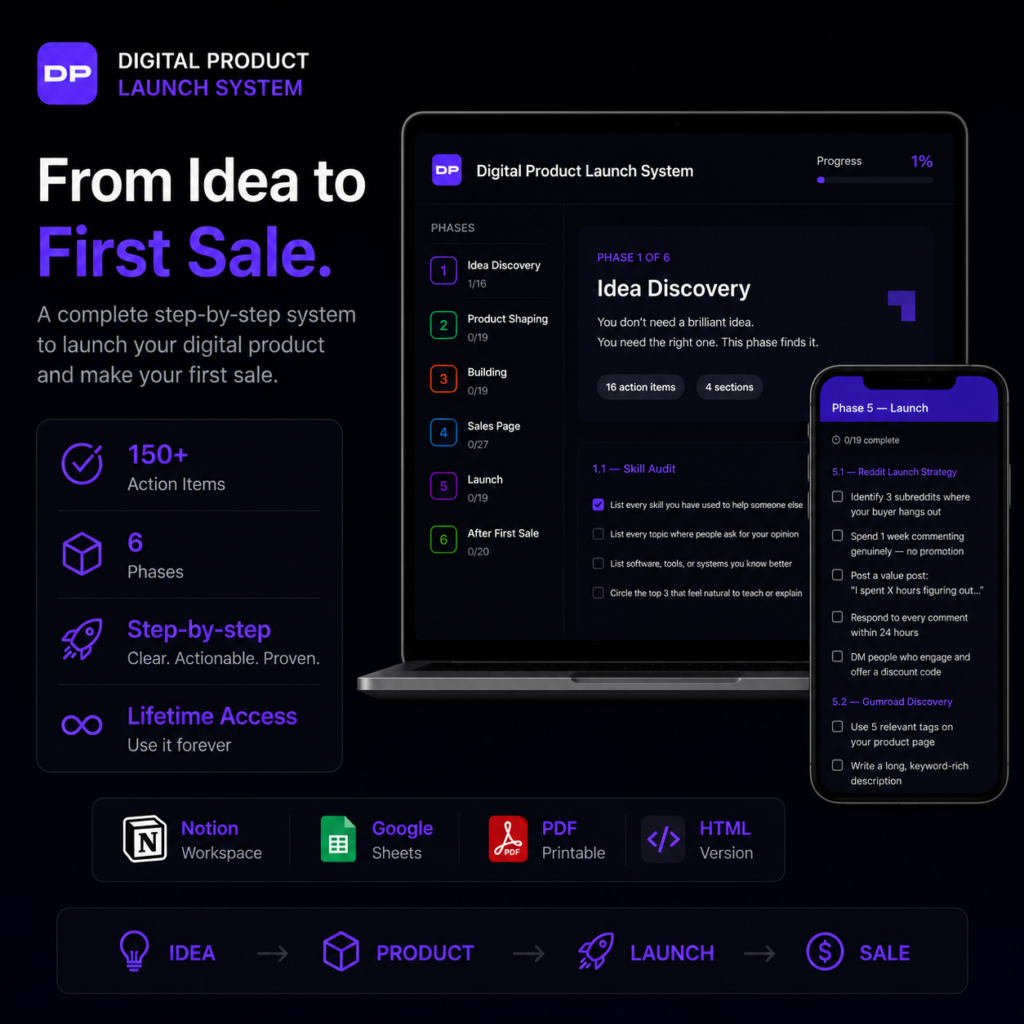
Most online courses give you information and ask you to figure out the execution yourself. That gap is exactly what the Digital Product Launch System closes. Rather than a passive course, it functions as an active launch environment, a guided workspace where you work through each of the six phases in sequence, with the structure already in place around you.
The core delivery is a Notion Launch Workspace: a complete operational environment that takes you from idea clarity through your first sale. Alongside it, companion formats give you flexibility in how you work. An Interactive Launch Guide, a Google Sheets Launch Tracker for those who prefer spreadsheets, and a Printable Launch System for those who think better on paper.
You do not need an existing audience to use it. You do not need to have launched before. You need an idea you believe in, the willingness to follow a structured process, and the clarity that shipping something real is better than refining something indefinitely.
The goal was never more ideas
The creator economy does not have an idea shortage. It has an execution shortage. Ideas are everywhere, in communities, in conversations, in the problems that people complain about publicly every day. What is scarce is the willingness to take one of those ideas and move it through a structured digital product launch system until something real exists on the other side.
The creators who build sustainable online businesses are not necessarily the most creative ones. They are the ones who learned to treat launching as a skill, something that improves with repetition, something that can be structured and systematized, something that does not depend on perfect confidence or perfect timing.
Collecting more ideas is not the answer. Building something people genuinely want is. And that requires a system, not more scattered inspiration. Your next product does not need another week of research. It needs a process that takes it from where it is today to somewhere people can find it, buy it, and actually use it.
That process already exists. The only remaining question is whether you will follow it.